The Inner Voices of Rosemary Brown (a work in progress)

“The Inner Voice of Rosemary Brown” is an historical intermedia interpretation of the life of composer and medium Rosemary Brown. This former cafeteria worker shot to pop fame in the early 1970s for producing compositions she claimed were communicated to her by dead composers. Exploring issues of identity, celebrity, and pop psychic phenomenology, “Rosemary Brown” provides the dramatic examination of gender and class in the context of suburban domesticity cast in the backdrop of 19th Century Romantic chromaticism, desire, and transcendence. This large piece for orchestra and chorus of 125 voices examines the allure of “romantic masterpieces” in popular culture and dramatizes an individual’s fantasies, spirituality, and psychic beliefs shaken under the requirements of proof.
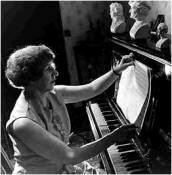
In 1969, Rosemary Brown claimed to be an earthly amanuensis to the spirits of discarnate composers such as Liszt, Chopin, Beethoven, Schumann, and Schubert. Her convincing compositions and unusual stories drew many followers. Her prodigious output including some 1500 compositions (including Beethoven’s 10th and 11th symphonies), several plays, volumes of poetry, papers on physics, paintings, essays, and three books are an unusual addition to music and cultural history. They are a testament to the phenomenally strange and complex conditions under which artistic achievements can flourish.
In her own words, Brown said she felt her hands were "taken over" by a spirit force, enabling her to play new music by Franz Liszt, who died in 1886. Brown had just three years of piano instruction and could not play by ear or improvise. Often struggling to notate the music after she had played it, she later said her "clairaudience" and "clairvoyance" developed to the point that she could take dictation from the spirit of a dead composer, even transcribing it directly to manuscript under the gaze of television cameras.
A feature in the BBC TV London News program in April 1969 rocketed Brown almost overnight from impoverished widowed-mother obscurity to south London psychic phenomenon. She was supported by contributions from people who believed in the occult like Sir George Trevelyan who established a trust fund to support her work. At first, she adapted with disarming ease to her new life. A chilly, threadbare Balham sitting room welcomed many important figures of classical music, including Leonard Bernstein, Andre Previn, Richard Rodney Bennett, Peter Katin, Hephzibah Menuhin, Humphrey Searle, Tamàs Vàsàry, William, Jean and then Julian Lloyd Webber. None came away thinking Rosemary Brown was a fraud and all were impressed by her sincerity and sensitivity. However, as her claims became more fantastical, her popularity and credibility began to wan. It is in this twilight of her popularity were my libretto begins.
Promoting her first autobiography, Unfinished Symphonies (1971) she made many public appearances in Europe and in New York. She played some of her music at the New York City Hall and appeared on The Johnny Carson Show. While she enjoyed the huge enthusiasm, the strain began to show and her health began to deteriorate. Her popularity faded years before the publication of her final and strangest book Look Beyond Today (1986). In it she detailed the surreal reality in which she reported to live populated by spirits, elves, 20-foot tall angels, dead animals, and deceased celebrities. She claimed that she was in frequent contact with the likes of George Bernard Shaw who dictated plays, Albert Einstein who gave her complex but indecipherable equations, Vincent Van Gough, Shakespeare, John Lennon, etc. The libretto is primarily comprised from passages in this book.
This musical work will offer a forum in which her revelations can be both dramatically portrayed and performed in a large-scale theatrical setting. The piece will be constructed to tease out the extreme personal tensions and publicity mechanisms that left her in ill heath and obscurity as well as bring to light many of her previously unperformed compositions.